JournoTECH

Loading

The Digital Solution to Lagos’s Waste Crisis: Can Blockchain Clean Up the City

By Matin Animashaun, Oluchukwu Nwabuikwu

 AI Generated Image for JournOTECH used to depict Lagos residents line up with their household waste.
AI Generated Image for JournOTECH used to depict Lagos residents line up with their household waste.

Lagos, Nigeria’s bustling economic hub and second most populous state, faces a mountain of a problem—literally. The city’s waste management system is struggling to keep pace with its rapidly growing population, which expands by about 1.2 million people per year as highlighted by the United Nations’ Environment Programme.

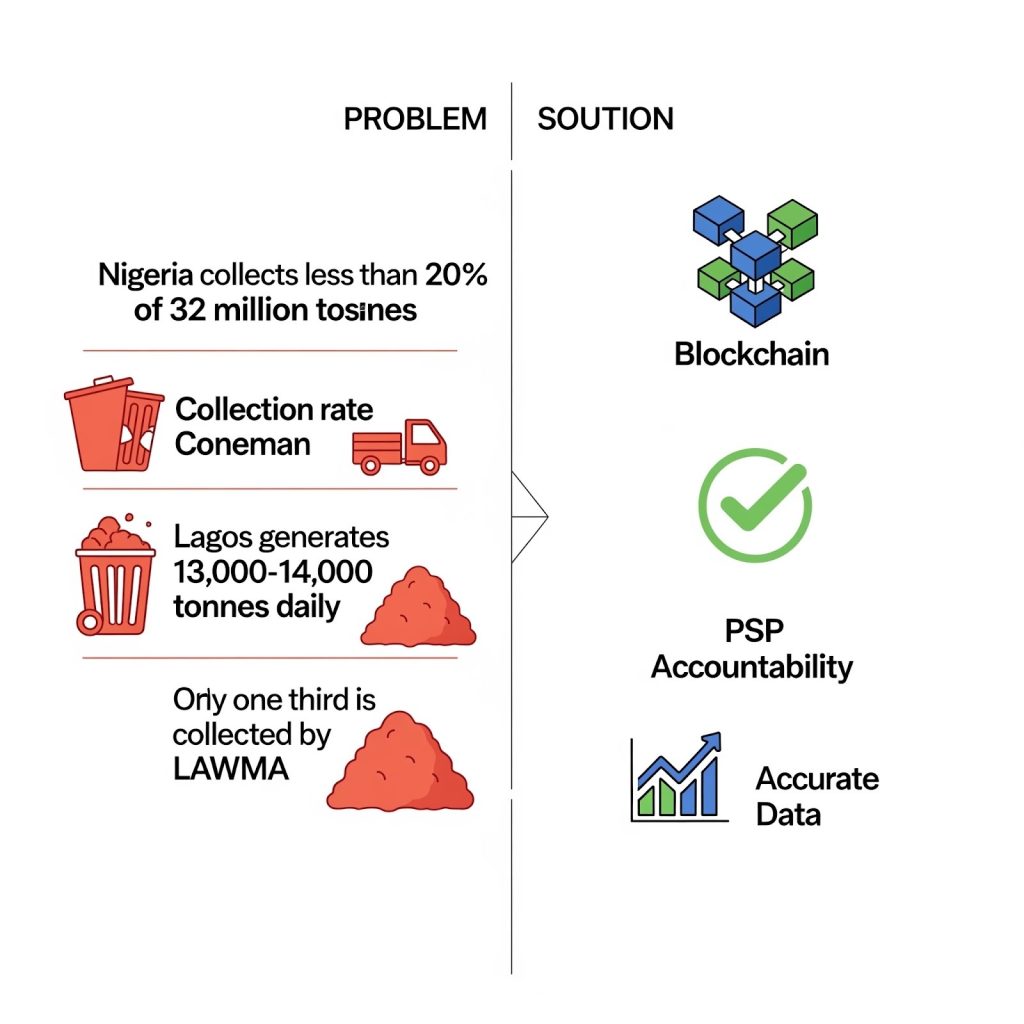
While the state government’s official figures suggest Lagos generates between 13,000 to 14,000 tonnes of waste daily (nearly 5 million tonnes a year), a 2025 analysis by two environmental experts revealed that only one third of this is collected by the Lagos State Waste Management Authority (LAWMA). This is part of a larger national challenge, as Nigeria collects less than 20% of the 32 million tonnes of annual solid waste it generates, significantly lower than the World Bank’s estimated average waste collection rate in sub Saharan Africa of about 44%. Experts also expect countries like Nigeria to generate three times more waste by 2050.

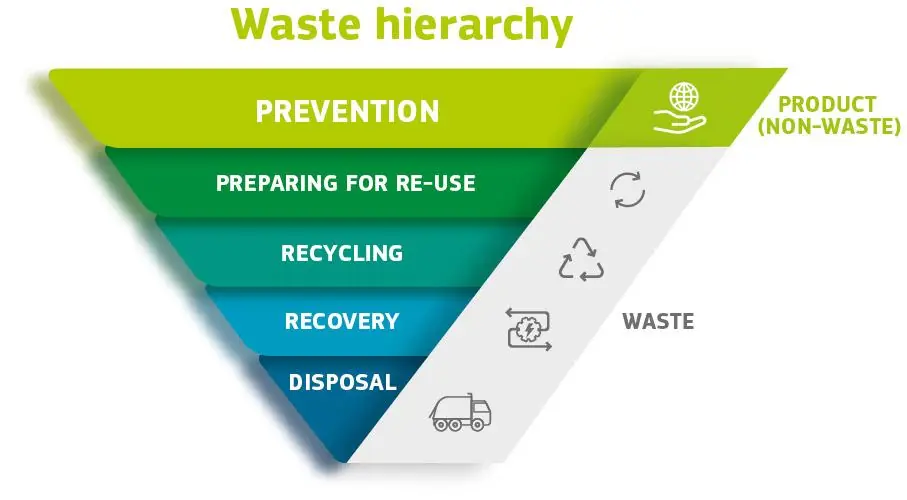
The city’s waste challenge is compounded by two major issues. First, the problem of inaccurate data. The government acknowledged in 2018 that the amount of waste generated far exceeded the official figure of 13,000 tonnes per day, and this lack of clear data makes effective management difficult. Second, the issue of poor waste hierarchy. According to a 2022 research article by Kehinde Allen-Taylor, Lagos skips critical steps in the waste hierarchy like prevention and recycling and proceeds straight to disposal. This systemic inefficiency has led to a massive informal waste economy taking over where official services fail.

Waste hierarchy by the European Commission’s Waste Framework Directive

LAWMA and its private service providers (PSPs) have attempted solutions. In February 2022, the state launched the “Adopt A Bin” programme to enhance waste management. This initiative saw 40,000 standard waste bins (green for general, blue for recyclables) delivered to homes and businesses to promote sorting at the source. However, the bins were too expensive for many, and a major issue persists: PSPs are known to ignore low-income areas because these communities are less profitable, leading to “black spots” of uncollected waste.

The Blockchain Solution

Nigeria’s launch of the Nigerian Circular Economy Program (NCEP) in 2024 has led stakeholders to consider blockchain technology. While often associated with cryptocurrencies, a blockchain’s core function as a distributed, immutable ledger offers a powerful solution to Lagos’s problems. First, it offers accountability. All waste collection activities, including those by LAWMA officials and the 364 PSPs, will be recorded on a decentralised database, which will stop private service providers from altering their data and keep them accountable for collecting waste in low-income areas. Second, it can provide accurate data. Its real-time tracking, similar to what the Berlin-based environmental technology company Cleanhub uses, could provide precise, auditable statistics on the volume and condition of waste collected. According to one report, Cleanhub has collected over 21 million kilograms of plastic waste as of October 2025. In Lagos, local companies like Motex Africa are already exploring this technology.

Challenges to Viability

The success of blockchain is conditional on addressing several major hurdles. Cost and scalability are significant concerns. Integrating this technology is very expensive, which is a major factor as Lagos State struggles to meet its internally generated revenue target for 2025. Furthermore, scaling a blockchain network to a city of over 20 million people can be technologically challenging and slow. Regulatory gaps are also a problem, as there are currently no local laws to compel stakeholders like PSPs to fully comply with blockchain-based reporting. Finally, data privacy conflicts pose a threat. Blockchain’s immutability clashes with Nigeria’s data protection laws, specifically the consumer’s “right to erasure”, as residents may not want their waste data permanently recorded on a publicly accessible database.

Ultimately, strong political will, adequate funding, public education, and regulatory frameworks are key. Most importantly, any system must integrate the informal waste workers who sustain much of Lagos’s recycling economy. If Lagos can address these prerequisites, the transparency and real-time tracking of blockchain could transform the state’s waste management system.

JournoTECH Convenes Legal Professionals to Tackle the Future of AI Governance and Security

London, United Kingdom — Legal professionals from several countries recently came together for a specialised training designed to help lawyers better understand the risks and responsibilities that come with using artificial intelligence in legal practice.

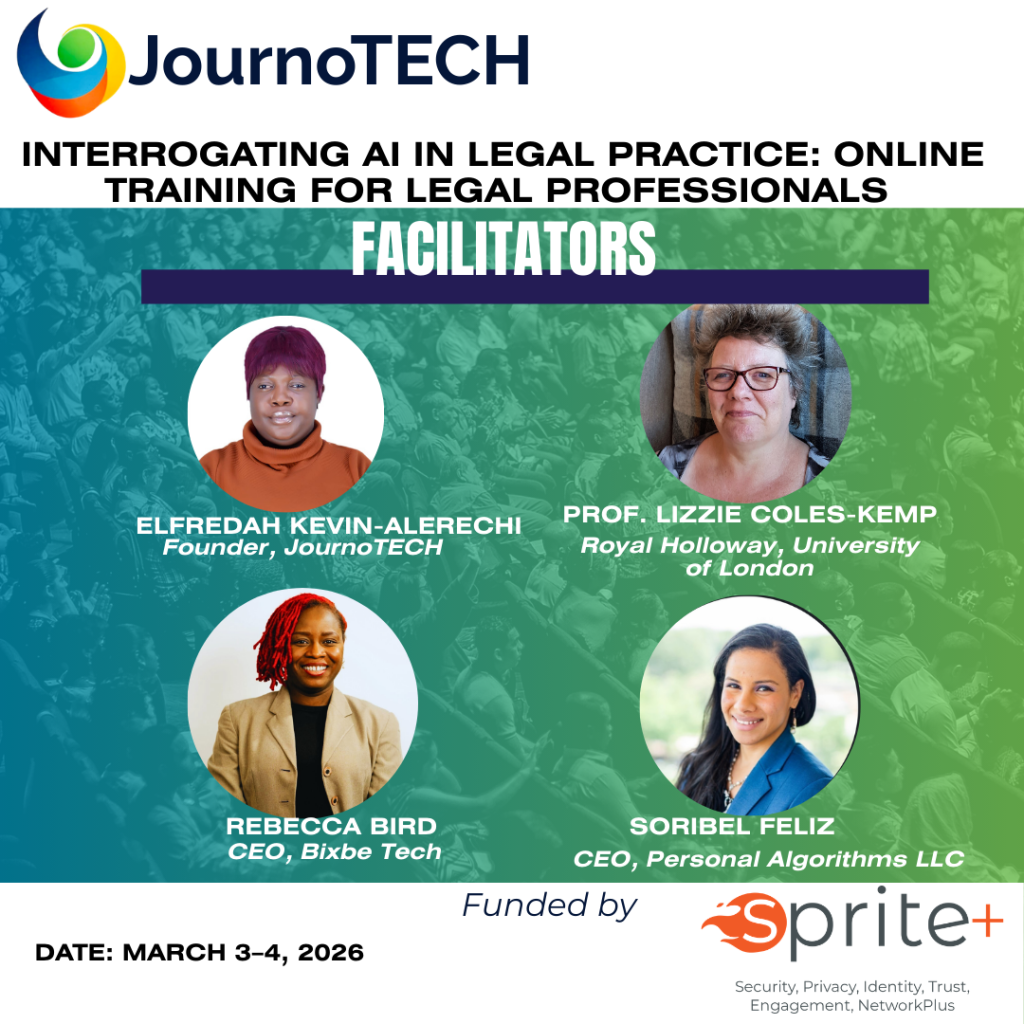
The two-day online programme, “Interrogating AI in Legal Practice: Security, Privacy, and Accountability for Legal Professionals,” took place on March 3–4, 2026. It was organised by JournoTECH with funding support from SPRITE+, a consortium of five UK universities led by the University of Manchester.

Thirty-four legal professionals were selected to take part in the training. They came from different backgrounds and levels of experience, including lawyers with more than 20 years in practice as well as mid-career practitioners. The participants included senior advocates, human rights lawyers, and professionals working in both private and government established from Nigeria, Ghana, Sierra Leone, and Zambia.

Many participants said the training helped address an important gap in AI knowledge within the legal profession. They explained that most AI training programmes available today are very general and often do not focus on the ethical duties, legal procedures, and confidentiality issues that lawyers deal with every day.

Opening the programme, Elfredah Kevin Alerechi, founder of JournoTECH, focused on connecting AI theory with real-life legal work. She introduced participants to specialised tools that can support legal workflows while emphasising that simply knowing about the technology is not enough.

Alerechi also spoke about some of the risks lawyers must consider when using AI systems, including bias, misinformation, and inaccurate results. She showed how platforms such as NewsAssist AI, Google NotebookLM, among others, can help legal professionals with tasks like transcription of depositions and analysing legal documents. At the same time, she reminded participants that technology should always be used carefully and with professional judgement.

Offering a wider perspective on responsibility in AI systems, Lizzie Coles-Kemp, Head of Information Security at Royal Holloway, University of London, spoke about what she described as a “sociotechnical” approach to responsibility. She explained that AI systems can sometimes create “responsibility gaps” when people rely too much on automated tools to make decisions.

According to Coles-Kemp, good AI governance is not only about deciding who is to blame when something goes wrong. It is also about building shared values, clear accountability, and transparency within organisations that use the technology.

The training also looked at the technical side of protecting sensitive legal information. Rebecca Bird, founder of BixBe Tech, cautioned lawyers against assuming that paid AI tools are automatically secure. She encouraged participants to treat every AI platform like a “stranger in the room” and to carefully check how their data is handled before sharing confidential information.

Meanwhile, Soribel Feliz, CEO of Personal Algorithms LLC, spoke about the growing problem of “Shadow AI.” This happens when employees use AI tools at work without approval from their organisation. She said law firms need clear policies and governance systems to ensure AI is used safely and responsibly.

Participants described the training as a valuable opportunity to receive practical guidance designed specifically for the legal profession. The sessions went beyond simple demonstrations of AI tools and explored deeper issues such as professional accountability, client confidentiality, and the full lifecycle of data privacy.

As the programme ended, organisers reminded participants that while AI can help automate many time-consuming tasks, the final responsibility for legal decisions always rests with the lawyer.

Participants said the training has equipped them with new strategies and frameworks that will help them guide their firms through the growing digital transformation of legal practice while maintaining strong ethical standards and public trust.

NewsAssist AI Founder Elfredah Kevin-Alerechi Selected for INSEAD AI Venture Lab Program

By Rosemary Nwaobasi

Elfredah Kevin-Alerechi, founder and developer of NewsAssist AI, has been selected for the INSEAD AI Venture Lab Sprint Cohort, a programme that brings together founders from around the world who are building bold and innovative ideas. NewsAssist AI was chosen from over 1,000 applications, highlighting its growing global impact.

The INSEAD Founder Sprint is a prestigious global accelerator that provides startups with mentorship, access to investors, and strategic partnerships to help scale their ideas. Since its launch in May 2025, NewsAssist AI has been used in 117 countries, reflecting the global demand for tools that streamline workflows while preserving originality.

NewsAssist AI Founder and Developer. Elfredah Kevin-Alerechi.

Over the next eight weeks, Kevin-Alerechi will collaborate with a diverse group of founders and learn from world-class mentors while building smarter solutions with AI at the core.

“This opportunity validates how timely and important our product is in today’s demanding world,” said Kevin-Alerechi. “What started as a solution to reduce the workload for journalists and newsrooms has grown beyond expectations. Today, academics, students, researchers, government agencies, and content creators also rely on NewsAssist AI.”

According to Kevin-Alerechi, acceptance into the INSEAD program represents more than recognition. It is an opportunity to refine the product and enhance its features for greater impact, deepen support for the growing community of both paid and free users, sharpen the fundraising strategy and investor readiness, learn from experienced founders who have raised millions and closed pre-seed rounds, and strengthen the pitch and roadmap for investors aligned with the mission.

NewsAssist AI is designed to revolutionise journalism and media practices through AI-powered tools for news creation, storytelling, and audience engagement. Originally built for journalists, it is now used across multiple sectors, including academics, legal practitioners, researchers, and content creators.

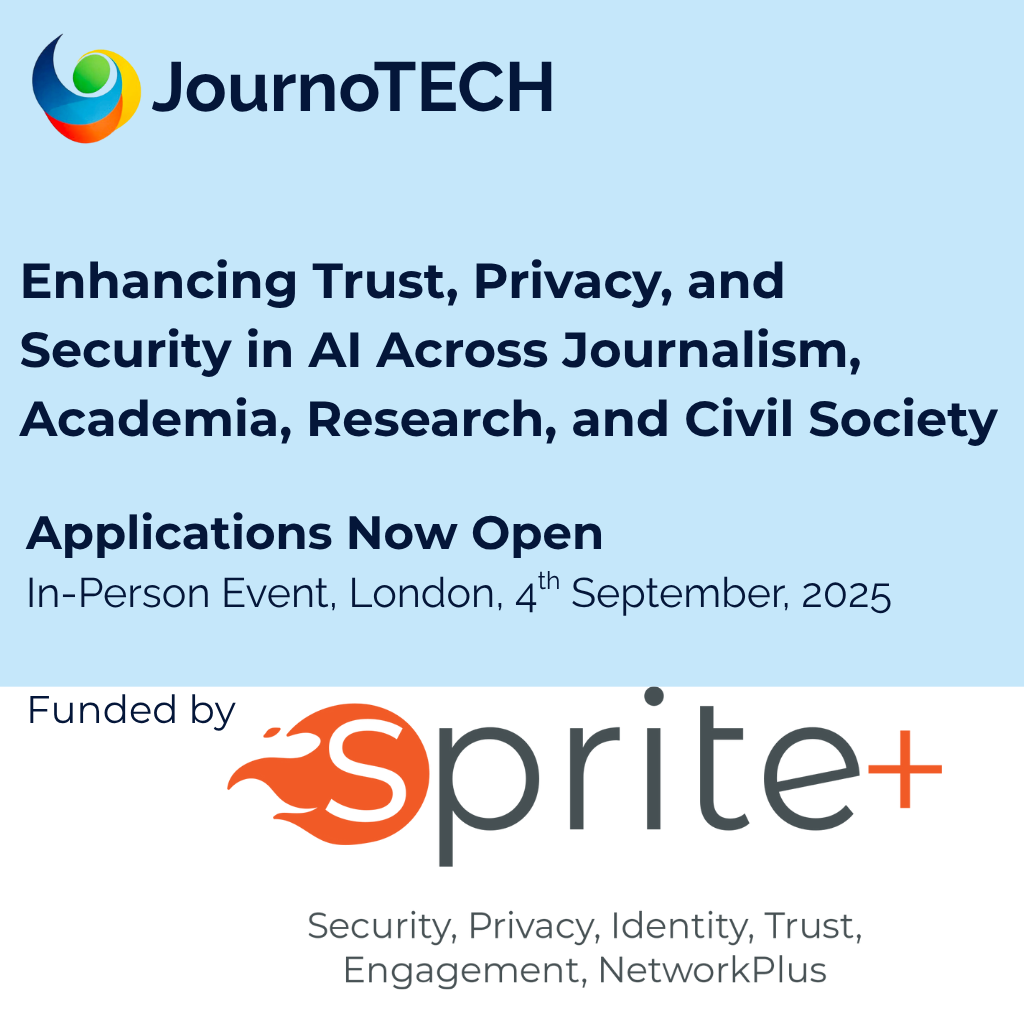
Applications Open for JournoTECH Event on Enhancing Trust, Privacy, and Security in AI Across Journalism, Academia, Research, and Civil Society

JournoTECH is excited to announce that applications are now open to attend and contribute to our upcoming in-person event in London, United Kingdom, on Thursday, 4th September 2025. The event focuses on “Enhancing Privacy, Trust, and Security in Artificial Intelligence (AI) across Journalism, Academia, Research, and Civil Society.

This event is funded by SPRITE+. SPRITE+ brings together people involved in research, practice, and policy with a focus on digital contexts. SPRITE+ is a consortium comprising the University of Manchester, Imperial College London, Lancaster University, Queen’s University Belfast, and the University of Southampton and is funded by UKRI EPSRC (UK Research and Innovation’s Engineering and Physical Sciences Research Council).

Participants will explore how AI tools impact privacy, trust, and security across journalism, civil society, academia, and research. It will focus on practical strategies for using AI responsibly, highlighting both risks and opportunities. Through real-world examples and cross-sector discussions, participants will gain tools and knowledge—including AI applications like NewsAssist AI—to apply AI ethically, protect sources, and uphold privacy, editorial integrity, and research standards when working with sensitive data or stories.

Our event will bring together a selected number of journalists, researchers, academics, civil society organizations, technologists, and innovators working at the intersection of AI, media, research, academia, and social impact.

Attendance is free, and applications are open to anyone able to attend in person in London. A limited number of travel expense reimbursements are available to support under-represented groups residing in the UK.

Please note: We are unable to provide visa support for applicants residing outside the UK.

🎯 Who Should Apply?

We welcome applications from:

  • Journalists, researchers, and academics exploring the impact of AI on their work
  • Professionals and technologists working on AI, privacy, trust, and data security
  • Civil society organisations working on AI privacy, data trust, and security
  • Practitioners supporting or researching the impact of AI on marginalised communities and information rights
  • Those interested in shaping ethical and inclusive AI futures

We are also inviting individuals and organisations who would like to share their work, research, or insights through panels, lightning talks, or roundtable discussions.

🚨 How to Apply
👉 Application Form here
Applications close on August 10, 2025.
Only selected applicants will be contacted by August 18, 2025.

Using AI and Google NotebooLM to Simplify Storylines for Investigative Podcasts

Using AI and Google NotebooLM to Simplify Storylines for Investigative Podcasts

At JournoTECH, we proudly supported The Colonist Report UK and Africa teams in using Google NotebookLM to produce an AI-driven flood investigation. This innovative tool allowed us to organize complex data, streamline our findings, and craft a compelling story about the environmental and community impacts of flooding.

Understanding that many people don’t have time to read lengthy reports, we turned this investigation into a podcast. By leveraging NotebookLM, we created a conversational format that simplifies the storyline, making it easier for our audience to follow the issues, investigations, and outcomes.

Podcasts bring these important stories to life, allowing listeners to engage while on the go—whether driving, cooking, or relaxing. This approach not only broadens accessibility but also ensures that critical investigations remain relatable and impactful for everyone, reinforcing our commitment to making complex issues more understandable and engaging for diverse audiences.

Stay connected! Follow us on social media for the latest updates.

Participants will explore topics such as understanding AI and its applications, using AI tools to enhance teaching, detecting AI-generated content and bias, and navigating challenges in AI integration. They will also learn how to localise AI solutions for their communities and gain skills to prepare students for future careers in an AI-driven world.

JournoTECH to Train Educators on AI Usage for an AI-Driven World

London, December 6, 2024 – JournoTECH, a platform focused on journalism training and tech skill development, has launched an exciting opportunity for educators to learn how to integrate Artificial intelligence (AI) technology into teaching. The program aims to help educators prepare their students for the demands of an AI-driven future while addressing challenges such as bias, ethical concerns, and the lack of localized AI solutions.

The training is designed for educators from developing nations, marginalised groups, and communities with limited access to technology. However, educators from the global North who want to scale up their teaching methods are also welcome. The program will focus on practical, hands-on learning, encouraging participants to come prepared to engage deeply with real-world applications of AI in education.

To ensure inclusivity, the training will be conducted in English, but translation services will be available to support participants who are not fluent in the language. However, attendees are encouraged to have a fair understanding of and ability to speak English to actively engage in discussions and activities.

Participants will explore topics such as understanding AI and its applications, using AI tools to enhance teaching, detecting AI-generated content and bias, and navigating challenges in AI integration. They will also learn how to localise AI solutions for their communities and gain skills to prepare students for future careers in an AI-driven world.

JournoTECH will offer support for internet access to participants interested in contributing data for AI models, with funding priority given to educators in higher and primary schools.

“This training is about empowering educators to harness AI for good. By equipping them with the right tools and knowledge, we’re helping to create inclusive, forward-thinking classrooms,” said Elfredah Kevin-Alerechi, founder of JournoTECH.

Applications are open now, with training delivered online and in select regional hubs.

With a focus on bridging the digital divide, JournoTECH’s initiative underscores the critical role of educators in shaping an equitable future where AI benefits everyone.